There is a particular kind of room that makes you put your phone down without deciding to. You sink into it. Your shoulders drop half an inch. In the 2026 home design style, that reaction is not an accident of good luck but the whole brief — a living room engineered for lingering rather than for looking impressive from the doorway. The shift is subtle but real: seating has grown lower and deeper, surfaces have softened, and the room's center of gravity has moved down toward the floor where actual life happens.
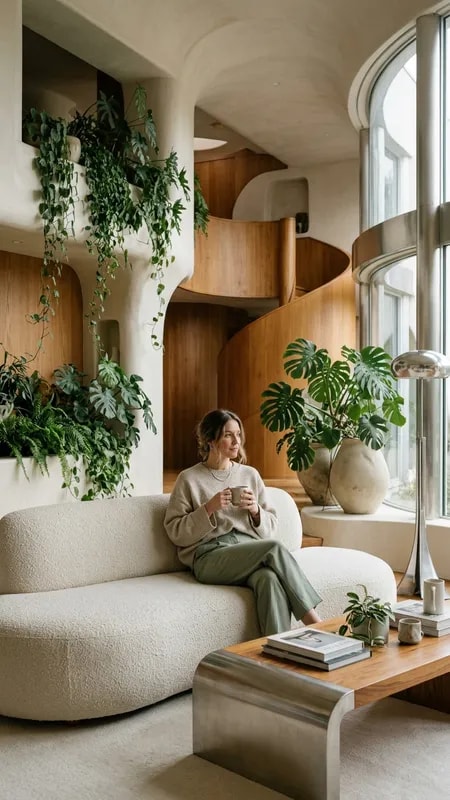
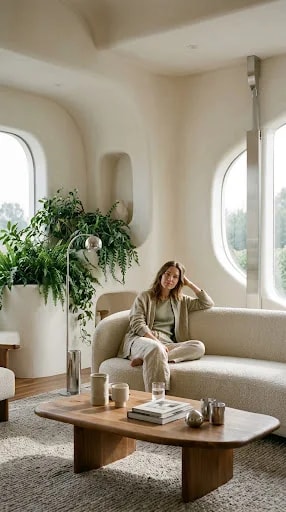
Start with the sofa, because everything else negotiates around it. The 2026 version is generously curved, upholstered in a nubby cream bouclé that reads as texture before it reads as color, and wide enough that one person can sprawl without apologizing. It sits low, which lowers the perceived ceiling and makes even a modest room feel held. Pair it with a coffee table that refuses geometry — an organic slab of pale wood, softly rounded at every corner, low enough that a cup of tea feels like the only reasonable next move. Books, ceramics, a small brass tray: objects with weight and warmth, arranged sparsely enough that each one gets to speak.
Light does the rest, and it should be handled with restraint. Diffused daylight through rounded windows gives the room its glow, and the key is to keep it diffuse — a sheer linen panel, a recessed niche painted the same color as the wall so shadows deepen instead of sharpening. Artificial light should be low and layered rather than overhead: a sculptural floor lamp with a paper or linen shade, perhaps a single warm bulb near the plant. Nothing that snaps on and flattens the room. The goal is the quality of light at four in the afternoon in late autumn, all year round.
The palette holds it together: cream, oatmeal, taupe, pale oak, and one muted green borrowed from the fern in the corner. Note how little contrast there is between wall, sofa, and floor — that continuity is what makes the space feel airy yet intimate. Built-in arched niches and softened corners do the same work, dissolving the hard edges that make rooms feel like boxes. A textured wool rug anchors the seating without competing, and the wood floor stays visible at the perimeter, warm and slightly imperfect underfoot.
What makes this a 2026 room rather than a 2021 one is intent. Warm minimalism used to mean emptiness; now it means capacity. Every object is there because someone might reach for it, and every surface is at the height where a hand naturally falls. The result is a room that does not perform. It waits — for a nap, for a long conversation, for nothing at all — and that, more than any single piece of furniture, is the style worth copying.