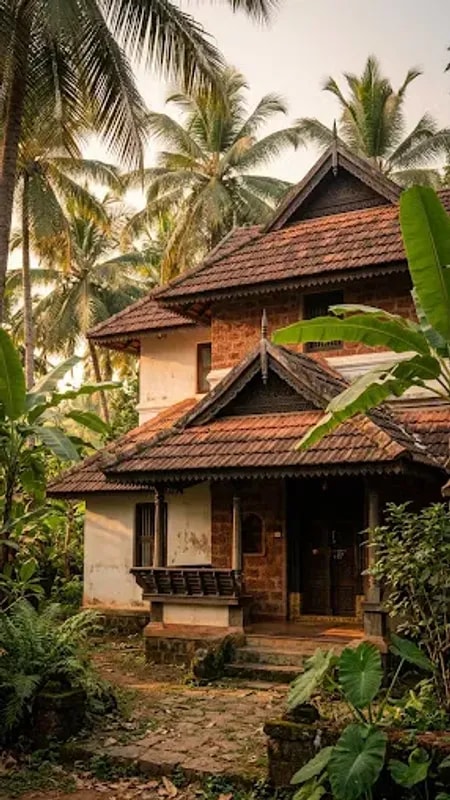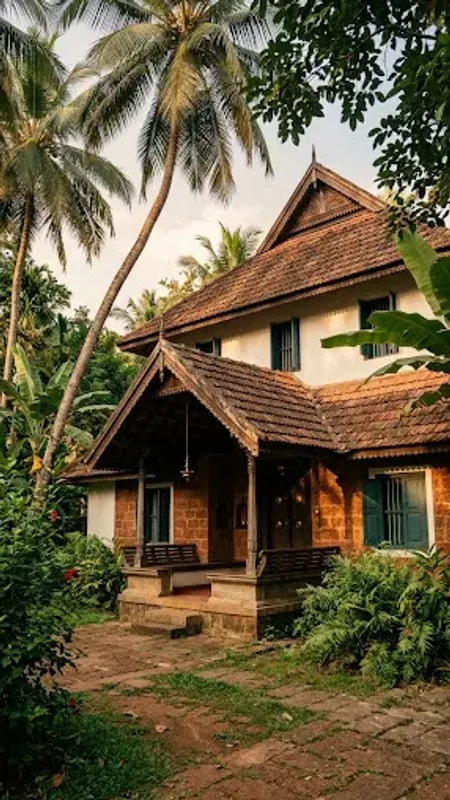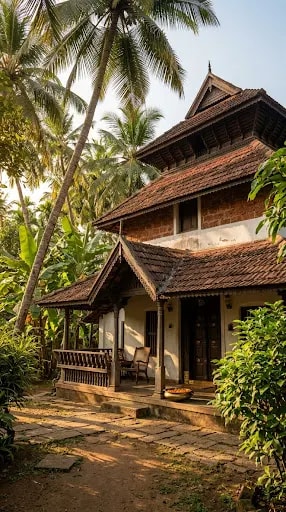
A Kerala home rarely announces itself all at once. Standing at the gate, you see the roofline first — those long, low slopes of terracotta tile, stacked in tiers so the rain has somewhere to go and the sun has something to hide behind. Only as you walk closer does the elevation reveal itself in layers: laterite rubble left exposed at the base, white plaster above, wooden pillars holding up the shade. The building unfolds at walking pace, which is exactly the point.
The stone-paved pathway does quiet work here. It is narrow enough to feel intentional, wide enough for two people to walk side by side, and it bends just enough that the front door stays partly hidden until the last few steps. That small delay matters. A straight, paved driveway puts everything on display from the road; a path lined with banana plants and shaded by coconut palms turns the approach into a threshold. By the time a visitor reaches the steps, they have already crossed from the heat of the street into something cooler and slower.
The veranda is the elevation's real centre of gravity, even though it sits in shadow. Wooden railings, turned pillars, a pair of chairs left facing outward — these details tell you the space is used, not just admired. In elevation drawings this zone often gets flattened into a rectangle of grey, but in life it is the transition that makes the rest of the house work: shoes come off here, conversations start here, the afternoon rain is watched from here. The dark wooden door behind it reads as a full stop, heavy and deliberate, framed by a lintel that carries the eye upward to the eaves.
Colour holds the whole composition together. The red of the clay tiles warms everything beneath them, the laterite gives the walls a rust-toned weight, and the white plaster offers the only real brightness in the frame. Against that, the greens of the garden read almost as architecture themselves, softening the corners and filling the gaps between roofline and sky. Golden-hour light does the rest, throwing dappled shadows across the plaster and pulling the texture out of the wood grain.
None of this requires a large plot or an elaborate budget. It asks for sequence, shade, and a willingness to let local materials age in place. Get the arrival right and the elevation takes care of itself.